

Hong Kong, SAR —The 41st Asia-Pacific Academy of Ophthalmology (APAO) Congress brought together thousands of ophthalmologists and vision scientists from across the region to spotlight advances shaping the future of eye care. Hosted at the Hong Kong Convention Center, the meeting emphasized innovation in retinal disease, imaging technologies, and translational research—an agenda reflected in the presentations from Stanford University’s Mahajan Lab.
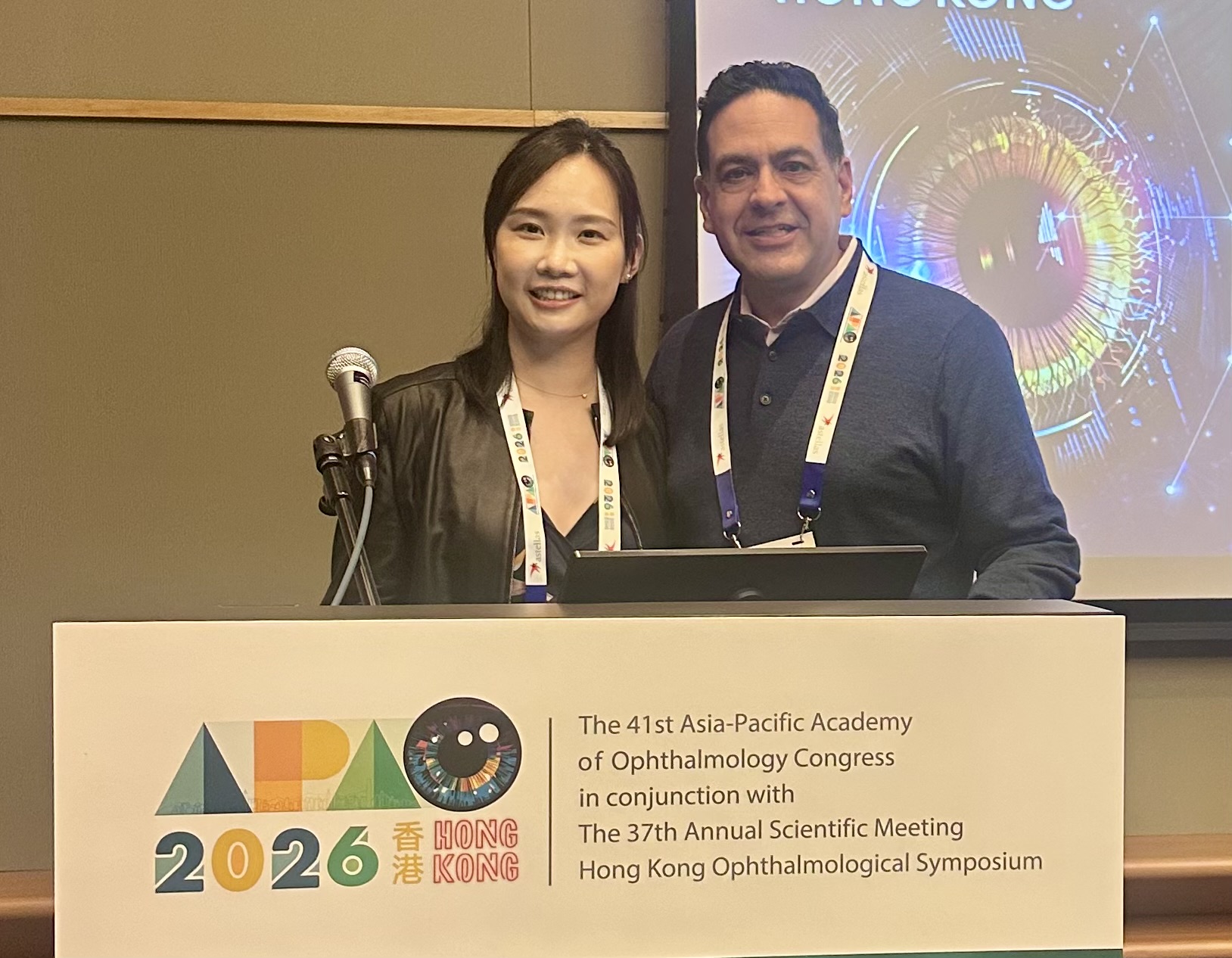
Vinit Mahajan M.D., Ph.D., Stanford professor and vice chair of ophthalmology research, and post-doctoral scholar Tsai-Chu Yeh M.D. highlighted the growing role of molecular and quantitative approaches in understanding and treating retinal disease. Their work underscored a broader shift within ophthalmology toward precision medicine, where detailed biological and imaging data inform both diagnosis and therapy.
Mahajan, a co-chair of the Oculomics section of CCOI, said. “By linking molecular signatures and high-resolution imaging directly to what we see in the clinic, our research gives us tools to move beyond one-size-fits-all care. For patients, it could mean earlier diagnosis, better prediction of disease progression, and treatments that are more precisely matched to their biology.”
He added, “For clinical trials, these approaches will allow us to identify the right patients, measure meaningful responses more accurately, and ultimately accelerate the development of therapies that truly change outcomes.”
Mahajan’s other talks focused on how molecular profiling can redefine clinical retina practice, drawing on the lab’s work integrating proteomics and clinical phenotyping to uncover disease mechanisms that are often invisible through conventional imaging alone.
Complementing this molecular perspective, Dr. Yeh also presented major advances in cell and gene therapy that are reshaping the future of ophthalmic diseases.
Dr. Yeh spoke on optogenetics as a disease-agnostic therapeutic platform, demonstrating clinical success in inherited retinal diseases and its rapid expansion into late-stage retinal degeneration where conventional treatments have long fallen short.
She said, “By bypassing damaged photoreceptors and directly restoring light sensitivity to downstream retinal neurons, optogenetics offers renewed visual potential even in advanced disease.”
Yeh further delved into organelle-based therapeutic strategies, highlighting emerging evidence from her own research that mitochondrial dysfunction plays a central role in geographic atrophy.
She explained, “The promise of mitochondrial transplantation is a novel approach to restore cellular energetics, improve retinal resilience, and potentially slow neurodegeneration. Together, these innovations signal a paradigm shift—from managing retinal disease to actively repairing and re-energizing the visual system at its most fundamental biological levels.”
She added, “What’s most exciting to me is that late-stage retinal disease is no longer the end of the road. From optogenetics to mitochondrial transplantation, these advances allow us to move beyond preservation and begin rebuilding retinal function.”
The meeting also provided an opportunity to reconnect with colleagues and collaborators from around the world. Mahajan and Yeh met with Ching-Yu Cheng MD, PhD from Singapore, Stephen H. Tsang MD, PhD from Columbia University, David Almeida MD, PhD from Erie Retina Research, Tai-Chi Lin MD from Taipei Veterans General Hospital, and Liping Yang MD, PhD from Peking University, exchanging perspectives on emerging therapies and the future of translational retinal science.
Following the meeting, Yeh was invited to Taipei Veterans General Hospital to present her work to students, clinicians, and faculty. Drawing on insights from the APAO Congress and her research at own Stanford, her lectures and discussions highlighted how innovations developed in U.S.-based research laboratories can be rapidly adapted and scaled across diverse healthcare systems worldwide—highlighting the truly global impact of precision medicine and translational retinal science.
Together, the Mahajan Lab’s contributions reflected the core themes of APAO 2026: innovation, integration, and translation. As the Asia-Pacific region continues to play a central role in global ophthalmology, the presence of Stanford researchers at the Hong Kong meeting reinforced the importance of cross-continental collaboration in advancing retinal science. Their work demonstrated how combining molecular insight with high-resolution imaging can move the field toward more personalized, data-driven care—an approach that resonated strongly throughout this year’s congress.