
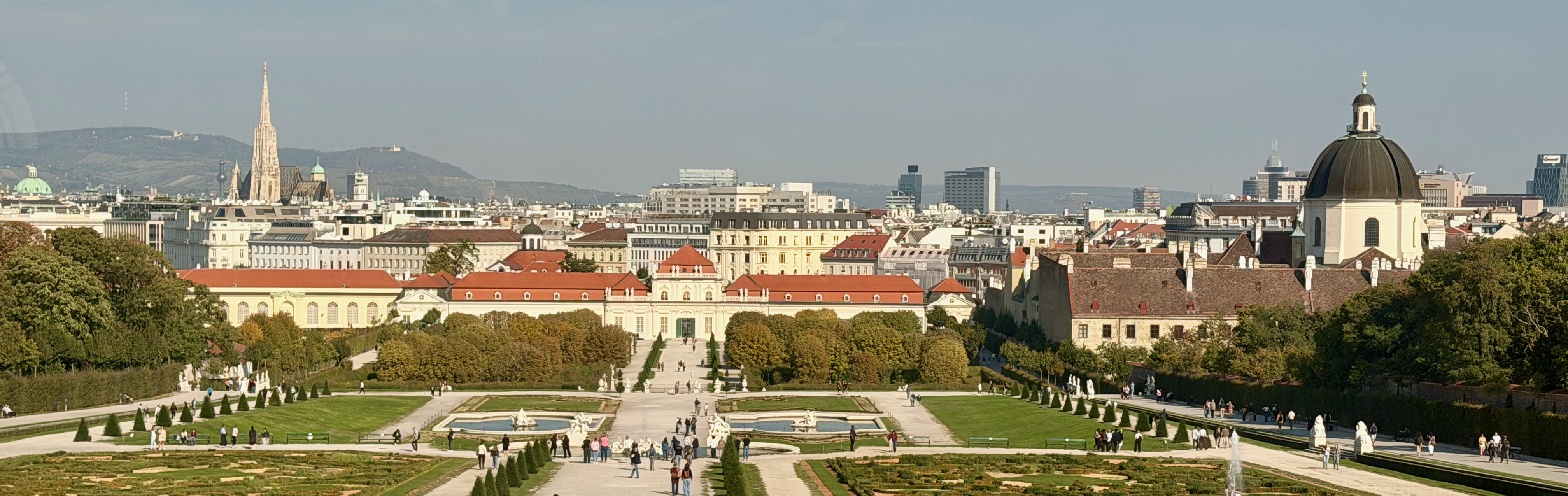
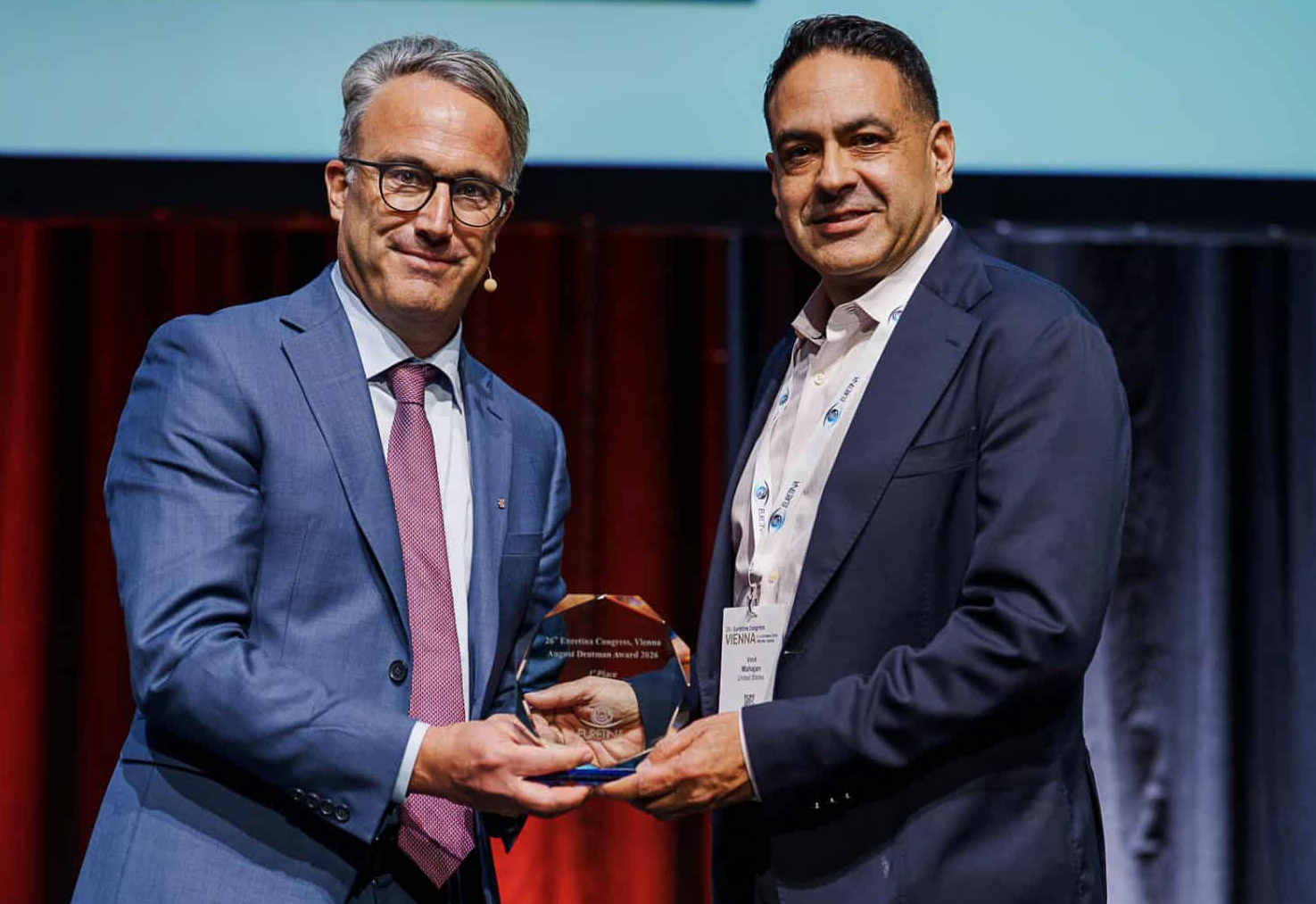
Vienna, Austria — A Stanford-led study explaining why complement inhibitors for geographic atrophy (GA), the advanced dry form of macular degeneration, may raise the risk of wet age-related macular degeneration received the 1st Place August Deutman Award for Best Free Paper at the 26th EURETINA Congress. The study topped a field of 1,349 Free Paper submissions.
Vinit Mahajan, M.D., Ph.D., Stanford professor and vice chair for research in the department of ophthalmology, presented the findings.
Mahajan said, "This award belongs to the whole team. The research was led by Tsai-Chu Yeh, a vitreoretinal surgeon and research fellow in my lab. It only came together because surgeons, scientists, and students across three institutions in two countries each contributed something essential: our Stanford retina surgeons collected the samples, our students and lab scientists carried out the analysis, Antoine Dufour at the University of Calgary assisted with proteomic analysis, and David Almeida's team in Erie provided critical clinical insight. Being recognized among so many outstanding studies is a tribute to them all."
The award was presented by Martin Zinkernagel M.D., Ph.D., professor and chair of the department of ophthalmology at the University of Bern and general secretary of EURETINA.
Why Would A Treatment Trigger Wet AMD?
Two complement-targeted drugs, pegcetacoplan and avacincaptad pegol, slow the expansion of GA. But clinical trials revealed an unexpected trade-off: treated dry AMD patients face a higher risk of converting to neovascular (wet) AMD. Until now, the biology behind this observation was unknown.
Using the Mahajan lab's TEMPO precision proteomics platform, the team analyzed aqueous humor, a liquid biopsy of fluid taken from living patients' eyes, from 75 participants in four groups: GA patients treated with pegcetacoplan, GA patients treated with avacincaptad pegol, untreated GA patients, and controls without GA.
Both drugs hit their targets, lowering C3 and C5 respectively. But treatment also triggered a striking immune response: markers of monocytes and macrophages (CD14, CD163, MRC1) rose sharply in treated eyes, pointing to macrophage activation and repolarization. This shift coincided with a selective rise in pro-angiogenic signals and a drop in a natural blood vessel inhibitor. VEGFA, the target of current wet AMD drugs, changed little. Although both drugs pushed eyes toward the same pro-angiogenic state, each left a distinct proteomic fingerprint.
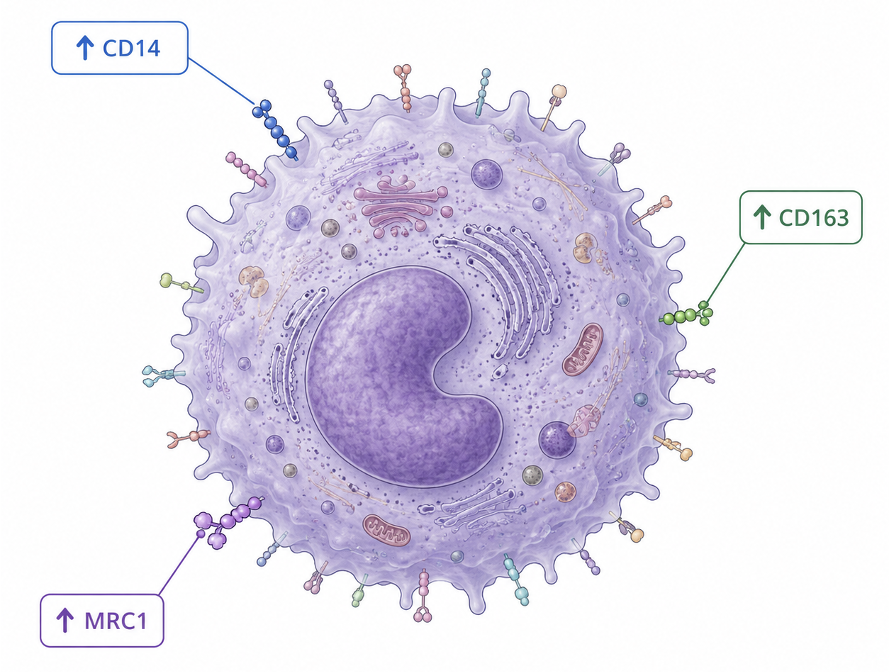
"Complement inhibitors help many patients, but our data suggest that blocking complement reprograms macrophages in a way that lowers the eye's resistance to new blood vessel growth," said Dr. Yeh. "Because we see this pattern across patients with different treatment durations, it appears to be a lasting local change."
Dr. David Almeida added, "Liquid biopsy proteomics could help us predict which patients are most at risk, choose the right drug, decide how closely to monitor, and design combination therapies that make these treatments safer."
About EURETINA and the August Deutman Award
The European Society of Retina Specialists (EURETINA) was founded in 2000 to advance research in retinal disease, vitreoretinal surgery, and macular disease, and its annual congress is the largest retina meeting in the world. The 2026 congress, held October 1st to the 4th in Vienna, drew attendees from more than 140 countries. The Best Free Paper award is named for August Deutman, M.D., Ph.D., EURETINA's founding president and longtime head of the Institute of Ophthalmology at Radboud University in Nijmegen. He was a pioneer in hereditary macular disease and vitreoretinal surgery who introduced vitreous surgery to the Netherlands.

The Team
The study was a collaboration between the Molecular Surgery Laboratory in the department of ophthalmology at Stanford's Byers Eye Institute; Erie Retina Research and the Center for Advanced Surgical Exploration; ClinOmicsAI; and the University of Calgary. Contributors include Tsai-Chu Yeh M.D., M.T.M.; visiting Caltech student Architesh Prasad; lab scientist Aneal M. Singh B.S.; postdoctoral fellows Akanksha, Madhumeeta Chadha, and Masters student William Rojas; Stanford retina surgeons Steven Sanislo M.D., Stephen Smith M.D., and Prithvi Mruthyunjaya M.D., M.H.S.; Antoine Dufour, PhD, of the University of Calgary; and David Almeida M.D., Ph.D. of Erie Retina Research.